Telecommunication Equipment · Cisco
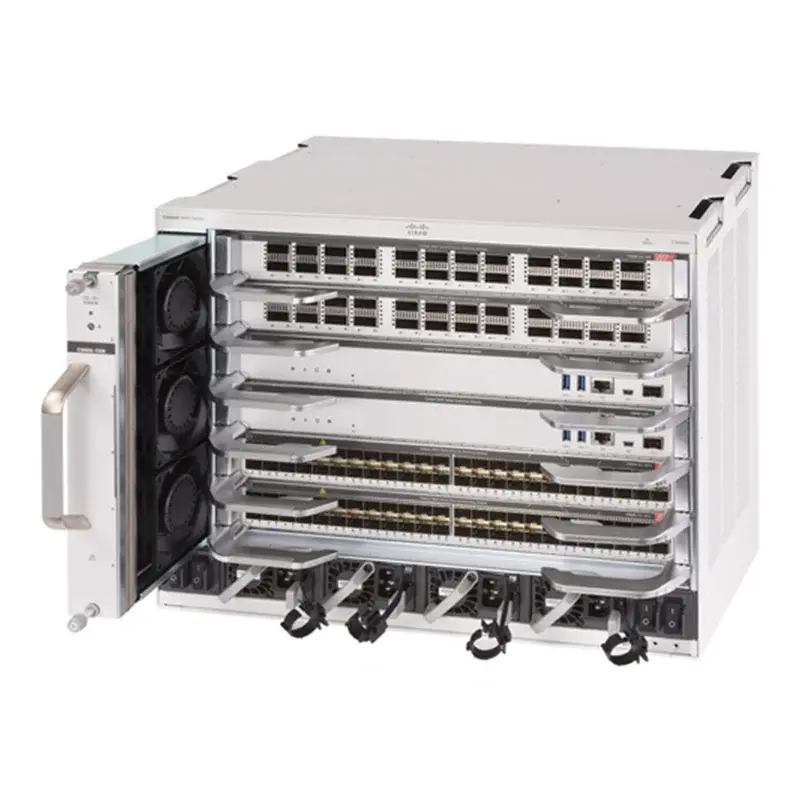
Cisco Catalyst 9600 Series Switches
Cisco Catalyst 9600Automated device provisioning is the ability to automate the process of upgrading software images and installing…
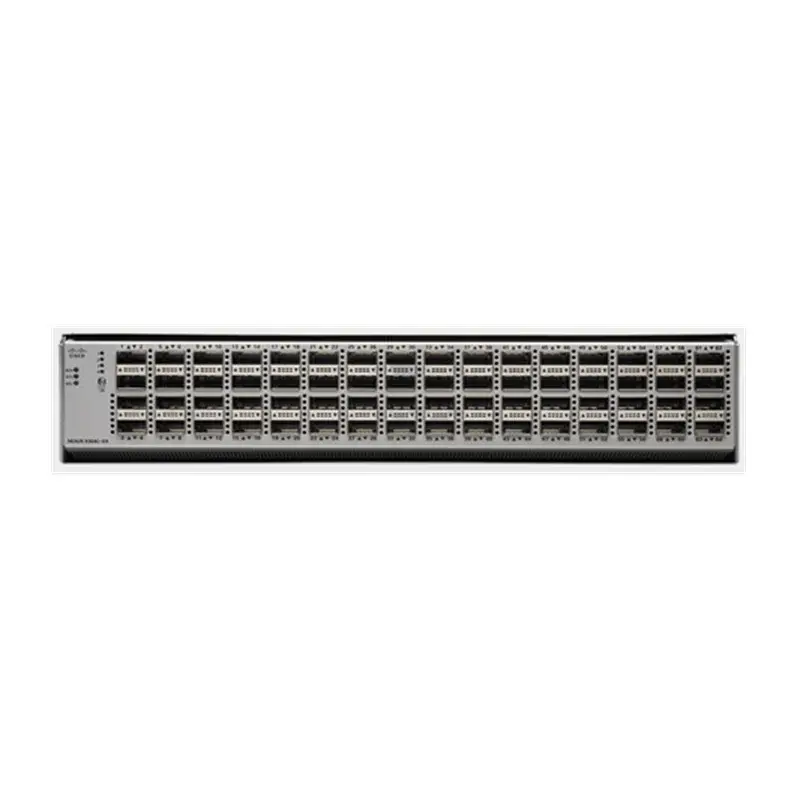
Based on Cisco® Cloud Scale technology, the Cisco Nexus® 9300-GX switches are the next generation of fixed Cisco Nexus 9000 Series Switches capable of supporting 400 Gigabit Ethernet (GE). With the increase in use cases for applications requiring Artificial Intelligence (AI) and Machine Learning (ML), the platform addresses the need for high-performance, power-efficient, compact switches in the networking infrastructure. These switches are designed to support 100G and 400G fabrics for mobile service provider environments, including the network edge, 5G, IoT, Professional Media Networking platform (PMN), and Network Functions Virtuapization (NFV) The platform introduces a backward-compatible 400G optical interface Quad Small Form-Factor Pluggable – Double Density (QSFP-DD) to transparently migrate existing data center fabrics from 40-Gbps and 100-Gbps speeds to 400 Gbps and also offers various lower port speeds and densities, including 10, 25, 50, and 200 Gbps using breakouts. The Cisco Nexus 9300-GX provides investment protection for customers, delivering higher performance to meet scaled out spine-leaf fabrics to support growing traffic for cloud applications.
Cisco provides two modes of operation for Cisco Nexus 9000 Series Switches. Organizations can deploy Cisco Application Centric Infrastructure (Cisco ACI®) or Cisco NX-OS mode.
Cisco ACI is a holistic, intent-driven architecture with centralized automation and policy-based application profiles. It provides a robust, transport network for dynamic workloads and is built on a network fabric that combines time-tested protocols with new innovations to create a highly flexible, scalable, and resilient architecture of low-latency, high-bandwidth links. This fabric delivers a network that can support the most demanding and flexible data center environments.
Designed for the programmable network, the Cisco NX-OS operating system automates configuration and management for customers who want to take advantage of the DevOps operation model and tool sets.
The specifications below are taken from the product catalog.
Switch models
Table 1 summarizes the Cisco Nexus GX Series Switches.
Table 1. Cisco Nexus 9300 switches
| Model | Description |
| Cisco Nexus 9316D Switch | 16 x 400/100-Gbps QSFP-DD ports |
| Cisco Nexus 93600CD Switch | 28 x 100/40-Gbps Quad Small Form-Factor Pluggable (QSFP28) and 8 x 400/100-Gbps QSFP-DD ports |
| Cisco Nexus 9364C Switch | 64 x 100/40-Gbps Quad Small Form-Factor Pluggable (QSFP28) |

Figure 1.
Cisco Nexus 9316D Switch

Figure 2.
Cisco Nexus 93600CD Switch
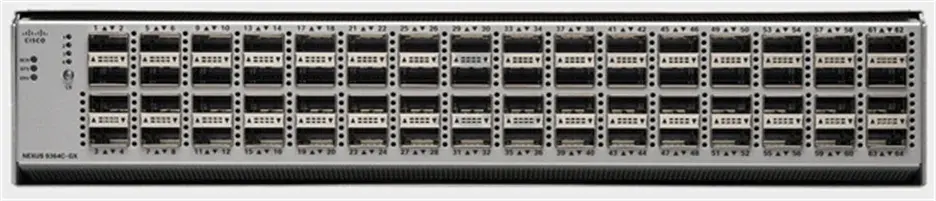
Figure 3.
Cisco Nexus 9364C Switch
Features and benefits
The Cisco Nexus 9300-GX Series provides the following features and benefits:
● Architectural flexibility
◦ Industry-leading Cisco Software-Defined Networking (SDN) solution and Cisco ACI® support
◦ Support for standards-based VXLAN EVPN fabrics, inclusive of hierarchical multi-site support (refer to VXLAN network with MP-BGP EVPN control plane for more information)
◦ Three-tier BGP architectures, enabling horizontal, non-blocking IPv6 network fabrics at web scale
◦ Segment Routing (SR and SRv6) allows the network to forward Multiprotocol Label Switching (MPLS) packets and engineer traffic without Resource Reservation Protocol (RSVP) Traffic Engineering (TE). It provides a control-plane alternative for increased network scalability and virtualization.
◦ Comprehensive protocol support for Layer 3 (v4 and v6) unicast and multicast routing protocol suites, including BGP, Open Shortest Path First (OSPF), Enhanced Interior Gateway Routing Protocol (EIGRP), Routing Information Protocol Version 2 (RIPv2), Protocol Independent Multicast Sparse Mode (PIM-SM), Source-Specific Multicast (SSM), and Multicast Source Discovery Protocol (MSDP)
● Extensive programmability
◦ Day-zero automation through Power On Auto Provisioning (POAP), drastically reducing provisioning time
◦ Industry-leading integrations for leading DevOps configuration management applications, such as Ansible, Chef, Puppet, and SALT. Extensive native YANG and industry-standard OpenConfig model support through RESTCONF/NETCONF
◦ Pervasive APIs for all switch Command-Line Interface (CLI) functions (JSON-based RPC over HTTP/HTTPs)
● High scalability, flexibility, and security
◦ Flexible forwarding tables support up to one million shared entries on GX models. Flexible use of TCAM space allows for custom definition of Access Control List (ACL) templates.
◦ IEEE 802.1ae MAC Security (MACsec) and Cloudsec (VTEP to VTEP encryption) support on all ports of 9300-GX models with speed greater than or equal to 1 Gbps; allows traffic encryption at the physical layer and provides secure server, border leaf, and leaf-to-spine connectivity
● Intelligent buffer management
◦ The platform offers Cisco’s innovative intelligent buffer management, which offers the capability to distinguish mice and elephant flows and apply different queue management schemes to them based on their network forwarding requirements in the event of link congestion.
◦ Intelligent buffer management functions include:
◦ Approximate Fair Dropping (AFD) with Elephant Trap (ETRAP). AFD distinguishes long-lived elephant flows from short-lived mice flows, by using ETRAP. AFD exempts mice flows from the dropping algorithm so that mice flows will get their fair share of bandwidth without being starved by bandwidth-hungry elephant flows. Also, AFD tracks elephant flows and subjects them to the AFD algorithm in the egress queue to grant them their fair share of bandwidth.
◦ ETRAP measures the byte counts of incoming flows and compares this against the user-defined ETRAP threshold. After a flow crosses the threshold, it becomes an elephant flow.
◦ Dynamic Packet Prioritization (DPP) provides the capability of separating mice flows and elephant flows into two different queues so that buffer space can be allocated to them independently. Mice flows—sensitive to congestion and latency—can take priority queue and avoid re-ordering that allows the elephant flows to take full link bandwidth.
● Remote Direct Memory Access (RDMA) over converged Ethernet – RoCE support
◦ The platform offers lossless transport for Remote Direct Memory Access (RDMA) over converged Ethernet with support of Data Center Bridging (DCB) protocols:
◦ Priority-based Flow Control (PFC) prevents drops in the network and pause-frame propagation per priority class
◦ Enhanced Transmission Selection (ETS) reserves bandwidth per priority class in network contention situations
◦ Data Center Bridging Exchange Protocol (DCBX) can discover and exchange priority and bandwidth information with endpoints
◦ The platform also supports Explicit Congestion Notification (ECN), which provides end-to-end notification per IP flow by marking packets that experienced congestion, without dropping traffic. The platform is capable of tracking ECN statistics, including the number of marked packets that have experienced congestion.
● LAN and SAN convergence
◦ Fibre Channel over Ethernet (FCoE) N-Port Virtualization (NPV) support enables the network administrator to control domain IDs and points of management on a Fibre Channel network as it scales. This feature enables LAN and SAN-converged networks on a lossless, reliable Ethernet network.
● Hardware and software high availability
◦ Virtual Port-Channel (vPC) technology provides Layer 2 multipathing through the elimination of Spanning Tree Protocol (STP). It also enables fully utilized bisectional bandwidth and simplified Layer 2 logical topologies without the need to change the existing management and deployment models.
◦ The 64-way Equal-Cost MultiPath (ECMP) routing enables the use of Layer 3 fat-tree designs. This feature helps organizations prevent network bottlenecks, increase resiliency, and add capacity with little network disruption.
◦ Advanced reboot capabilities include hot and cold patching.
◦ The switches use hot-swappable Power-Supply Units (PSUs) and fans with N+1 redundancy.
● Purpose-built Cisco NX-OS Software operating system with comprehensive, proven innovations
◦ A single binary image supports every switch in the Cisco Nexus 9000 Series, simplifying image management. The operating system is modular, with a dedicated process for each routing protocol: a design that isolates faults while increasing availability. In the event of a process failure, the process can be restarted without loss of state. The operating system supports hot and cold patching and online diagnostics.
◦ Data Center Network Manager (DCNM) is the network management platform for all Cisco NX-OS-enabled deployments, spanning new fabric architectures, IP Fabric for Media, and storage networking deployments for the Cisco Nexus-powered data center. Accelerate provisioning from days to minutes and simplify deployments from day zero through day N. Reduce troubleshooting cycles with graphical operational visibility for topology, network fabric, and infrastructure. Eliminate configuration errors and automate ongoing change in a closed loop, with templated deployment models and configuration compliance alerting with automatic remediation. Enjoy a real-time health summary for fabric, devices, and topology. Correlated visibility for fabric (underlay, overlay, virtual and physical endpoints), including compute visualization with VMware.
◦ Network traffic monitoring with Cisco Nexus Data Broker builds simple, scalable, and cost-effective network Test Access Points (TAPs) and Cisco Switched Port Analyzer (SPAN) aggregation for network traffic monitoring and analysis.
● Cisco Network Assurance Engine (NAE)
◦ Cisco NAE continuously verifies if the network infrastructure is operating as per policy intent. It leverages the power of mathematical models to reason on behalf of the operator in policy, configuration, and dynamic state level. NAE can precisely indicate problems in the network, identify which application or part of network is impacted, identify the root cause of the problem, and suggest how to fix it. Its continuous verification approach transforms day-2 operations from reactive to proactive mode and it does so without using any packet data. NAE helps avoid outages by predicting the impact of changes, reducing network-related IT incidents and shrinking the mean time to repair by up to 66 percent. NAE also helps assure network security and segmentation compliance. To learn more about NAE, visit: https://www.cisco.com/c/en/us/products/data-center-analytics/network-assurance-engine/index.html.
Specifications
Table 2 lists the specifications for the Cisco Nexus GX Series fixed switches.
Table 2. Cisco Nexus 9300-GX Series switch specifications
| Item | Specifications | ||
| Device | N9K-C9316D-GX | N9K-C93600CD-GX | N9K-C9364C-GX |
| Ports | ● 16 x 400/100/40-Gbps QSFP-DD ports | ● 28 x 100/40-Gbps QSFP28 ports and 8 x 400/100-Gbps QSFP-DD ports | ● 64 x 100/40-Gbps QSFP28 ports |
| Supported speeds | ● 40/100/400-Gbps Ethernet ● Breakout supported on all ports, 1-16: 4x100, 8x50, 2x50, 4x25, 4x10 ● 10G w/QSA | ● 40/100-Gbps on downlinks ● 40/100/400-Gbps on uplinks ● Breakout supported on ports, 25-36: 2x50, 4x10, 4x25G ● 10G w/QSA | ● 40/100-Gbps ● Breakout supported: ● 2x50, 2x25, 2x10 on all ports ● 4x10, 4x25G on all odd numbered ports ● 10G w/QSA |
| CPU | ● 4 cores | ● 4 cores | ● 4 cores |
| System memory | ● 32 GB | ● 32 GB | ● Up to 32 GB |
| SSD Drive | ● 128 GB | ● 128 GB | ● 128 GB |
| System buffer | ● 80 MB | ● 80 MB | ● 80 MB |
| Management ports | ● 2 ports: 1 RJ-45 and 1 SFP+ | ● 2 ports: 1 RJ-45 and 1 SFP+ | ● 2 ports: 1 RJ-45 and 1 SFP+ |
| USB Ports | ● 1 | ● 1 | ● 1 |
| RS-232 serial ports | ● 1 | ● 1 | ● 1 |
| Power Supplies | ● 1100W AC, 1100W DC, 1100W HVAC/HVDC | ● 1100W AC, 1100W DC, 1100W HVAC/HVDC | ● 2000W AC, 2000W DC, 2000W HVAC/HVDC |
| Typical power (AC) | ● 420W | ● 586W | ● 811W |
| Maximum power (AC) | ● 1010W | ● 1071W | ● 1622W |
| Input voltage (AC) | ● 100 to 240V | ● 100 to 240V | ● 100 to 240V |
| Input voltage (High-Voltage AC [HVAC]) | ● 100 to 277V | ● 100 to 277V | ● 100 to 277V |
| Input voltage (DC) | ● –40 to –72V | ● –40 to –72V | ● –40 to –72V |
| Input voltage (High-Voltage DC [HVDC]) | ● –240 to –380V | ● –240 to –380V | ● –240 to –380V |
| Frequency (AC) | ● 50 to 60 Hz | ● 50 to 60 Hz | ● 50 to 60 Hz |
| Fans | ● 5+1 redundancy | ● 5+1 redundancy | ● 3+1 redundancy |
| Airflow | ● Port-side intake and exhaust | ● Port-side intake and exhaust | ● Port-side intake and exhaust |
| Physical dimensions (H x W x D) | ● (H x W x D): 3.38 x 17.37 x 22.27 in. (8.59 x 44.13 x 56.58 cm) | ● (H x W x D): 1.72 x 17.37 x 25.5 in. (4.37 x 44.13 x 64.8 cm) | ● Dimensions (H x W x D): 3.39 x 17.41 x 22.59 in. (8.61 x 44.23 x 57.4 cm) |
| Acoustics | ● 73.2 dBA at 50% fan speed, 81.8 dBA at 70% fan speed, and 88.8 dBA at 100% fan speed | ● 73.2 dBA at 50% fan speed, 81.8 dBA at 70% fan speed, and 88.8 dBA at 100% fan speed | ● 77.3 dBA at 50% fan speed, 88.6 dBA at 70% fan speed, and 95.8 dBA at 100% fan speed |
| RoHS compliance | ● Yes | ● Yes | ● Yes |
| Mean Time Between Failure (MTBF) | ● 323,140 hours | ● 295,515 hours | ● 237,760 hours |
| Minimum ACI image | ● ACI-N9KDK9-14.2(2e) | ● ACI-N9KDK9-14.2(2e) | ● ACI-N9KDK9-14.2(3) |
| Minimum NX-OS image | ● NXOS-9.3.3 | ● NXOS-9.3.3 | ● NXOS-9.3.3 |
The Cisco Nexus GX Series also introduces support of single-chip ACI spine-and-leaf functionality to enable customers to use a given GX series device, either in ACI spine or ACI leaf deployment for fully flexible deployments.
Table 3. ACI support
| Item | N9K-C9316D-GX | N9K-C93600CD-GX | N9K-C9364C-GX |
| ACI spine | Yes | Future | Future |
| ACI leaf | Future | Yes | Yes |
Performance and scalability
Table 4 lists the performance and scalability specifications for the Cisco Nexus GX Series Switches.
Table 4. Performance and scalability specifications
| Item | Cisco Nexus 9300-GX Series Switches |
| Maximum number of IPv4 Longest Prefix Match (LPM) routes** | 896,000 |
| Maximum number of IPv4 host entries** | 896,000 |
| Maximum number of MAC address entries** | 256,000 |
| Maximum number of multicast routes | 32,000 |
| Number of Interior Gateway Management Protocol (IGMP) snooping groups | Shipping: 8000 Maximum: 32,000 |
| Maximum number of Access-Control-List (ACL) entries | Per slice of the forwarding engine: ● 5000 ingress ● 2000 egress ● Max: 20,000 ingress, 8000 egress |
| Maximum number of VLANs | 3967 |
| Number of Virtual Routing and Forwarding (VRF) instances | Shipping: 1000 Maximum: 16,000 |
| Maximum number of ECMP paths | 64 |
| Maximum number of port channels | 512 |
| Maximum number of links in a port channel | 32 |
| Number of active SPAN sessions | 4 |
| Maximum number of VLANs in Rapid per-VLAN Spanning Tree (RPVST) instances | 3967 |
| Maximum number of Hot-Standby Router Protocol (HSRP) groups | 490 |
| Maximum number of Multiple Spanning Tree (MST) instances | 64 |
| Flow-table size used for Cisco Tetration Analytics platform*** | 64,000 |
| Number of Network Address Translation (NAT) entries | 1023 |
More templates and greater scalability are on the roadmap. Refer to the Cisco Nexus 9000 Series Verified Scalability Guide and Cisco Application Policy Infrastructure Controller for the latest, exact scalability numbers validated for specific software.
Table 5. Weight
| Component | Weight |
| Cisco Nexus 9316D-GX without power supplies or fans | 27 lbs (12.2 kg) |
| Cisco Nexus 93600CD-GX without power supplies or fans | 27 lbs (12.2 kg) |
| Cisco Nexus 9364C-GX without power supplies or fans | 39.2 lbs (17.8 kg) |
| 2000W AC power supply | 2.2 lbs (1 kg) |
| 2000W DC power supply | 2.2 lbs (1 kg) |
| 2000W HVAC/HVDC power supply | 2.42 lbs (1.1 kg) |
| 1100W AC power supply | 2.42 lbs (1.1 kg) |
| 1100W DC power supply | 2.45 lbs (1.11 kg) |
| 1100W HVAC/HVDC power supply | 2.46 lbs (1.12 kg) |
| Fan tray: NXA-FAN-35CFM-PE or NXA-FAN-35CFM-PI | 0.25 lbs (0.1 kg) |
| NXA-FAN-160CFM2PI or NXA-FAN-160CFM2PE | 1.3 lbs (0.59 kg) |
Regulatory standards compliance
Table 6 summarizes regulatory standards compliance for the platform.
Table 6. Regulatory standards compliance: Safety and EMC
| Specification | Description |
| Regulatory compliance | Products should comply with CE Markings according to directives 2004/108/EC and 2006/95/EC. |
| Safety | ● UL 60950-1 Second Edition ● CAN/CSA-C22.2 No. 60950-1 Second Edition ● EN 60950-1 Second Edition ● IEC 60950-1 Second Edition ● AS/NZS 60950-1 ● GB4943 |
| EMC: Emissions | ● 47CFR Part 15 (CFR 47) Class A ● AS/NZS CISPR22 Class A ● CISPR22 Class A ● EN55022 Class A ● ICES003 Class A ● VCCI Class A ● EN61000-3-2 ● EN61000-3-3 ● KN22 Class A ● CNS13438 Class A Note: Cisco Nexus N9K-C9364C passes EMC Radiated Emissions standards in all configurations, with the only exception being if more than 40 pluggable optics of Cisco part number 10-3142-02 (or 10-3142-01) are used. |
| EMC: Immunity | ● EN55024 ● CISPR24 ● EN300386 ● KN 61000-4 series |
| RoHS | The product is RoHS-6 compliant with exceptions for leaded Ball Grid-Array (BGA) balls and lead press-fit connectors. |
Supported optics: Pluggable
Warranty
The Cisco Nexus 9300 platform switches have a 1-year limited hardware warranty. The warranty includes hardware replacement with a 10-day turnaround from receipt of a Return Materials Authorization (RMA).
Service and support
Cisco offers a range of professional, solution, and product support services for each stage of your Cisco Nexus 9300 platform deployment:
● Cisco Data Center Quick Start Service for Cisco Nexus 9000 Series Switches - This offering provides consulting services that include technical advice and assistance to help deploy Cisco Nexus 9000 Series Switches.
● Cisco Data Center Accelerated Deployment Service for Cisco Nexus 9000 Series Switches - This service delivers planning, design, and implementation expertise to bring your project into production. The service also provides recommended next steps, an architectural high-level design, and operation-readiness guidelines to scale the implementation to your environment.
● Cisco Migration Service for Cisco Nexus 9000 Series Switches - This service helps you migrate from Cisco Catalyst® 6000 Series Switches to Cisco Nexus 9000 Series Switches.
● Cisco product support – Our support service is available globally 24 hours a day, 7 days a week, for Cisco software and hardware products and technologies associated with Cisco Nexus 9000 Series Switches. Enhanced support options delivered by Cisco also include solution support for Cisco ACI, Cisco SMARTnet™ Service, and Cisco Smart Net Total Care®* Service.
Automated device provisioning is the ability to automate the process of upgrading software images and installing…
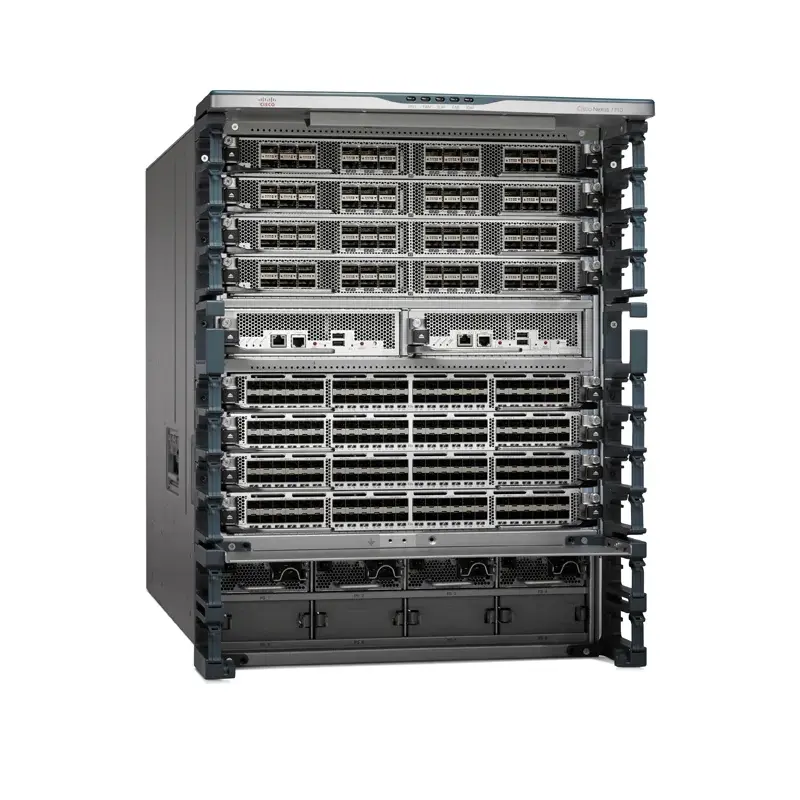
Powered by Cisco NX-OS, the Cisco Nexus 7700 switches deliver a comprehensive set of features with nonstop operations…
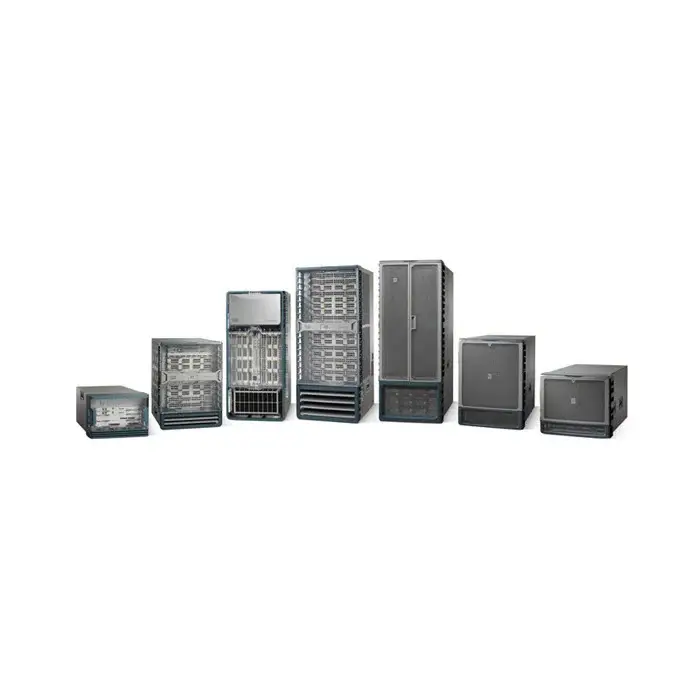
Cisco Nexus® 7000 Series Switches combine high levels of scalability with operational flexibility. Cisco Nexus 7000…
Send a request to get help choosing equipment and a connection plan.